Partial and mixed occupancy
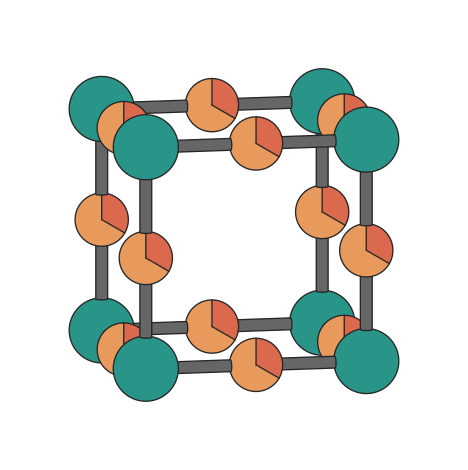
Hofmann can render sites with partial or mixed crystallographic occupancy. Such mixed sites are drawn as pie wedges; one wedge per species, with each wedge’s angle equal to that species’ occupancy.
Constructing a mixed site
Mixed sites are expressed by passing a Composition value in
the species list, in place of a plain string label:
import numpy as np
from hofmann import Composition, StructureScene, Frame

anion = Composition({"F": 2 / 3, "O": 1 / 3})
scene = StructureScene(
    species=["Ti", anion, anion, anion],
    frames=[Frame(
        coords=np.array([
            [0.0, 0.0, 0.0],
            [1.9, 0.0, 0.0],
            [0.0, 1.9, 0.0],
            [0.0, 0.0, 1.9],
        ]),
        lattice=np.eye(3) * 3.8,
    )],
)
Vacancies
When a Composition’s occupancies sum to less than one, the
missing fraction is treated as a vacancy fraction:
fe_partial = Composition({"Fe": 0.7}) # 70% Fe, 30% vacancy
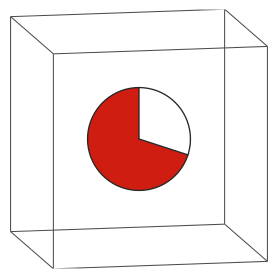
The vacancy wedge is filled with the canvas background colour by
default. A custom vacancy colour can be set by passing the
vacancy_colour field on
RenderStyle.
From a pymatgen Structure
A pymatgen Structure represents partial
occupancy and species disorder natively.
from_pymatgen() reads this directly: any site with
more than one species, or with a single species at occupancy below
one, becomes a Composition in the resulting scene.
from hofmann import StructureScene

# 'structure' is any pymatgen Structure
scene = StructureScene.from_pymatgen(structure)
scene.render_mpl("output.svg")
Loading from a CIF file
CIFs can be loaded with pymatgen and passed through to
from_pymatgen(). For example:
data_disordered_site
_chemical_formula_sum    'Fe0.7 Mn0.3'
_cell_length_a       2.8
_cell_length_b       2.8
_cell_length_c       2.8
_cell_angle_alpha    90.0
_cell_angle_beta     90.0
_cell_angle_gamma    90.0

_space_group_name_H-M_alt    'P 1'
_space_group_IT_number       1

loop_
  _space_group_symop_operation_xyz
  'x, y, z'

loop_
  _atom_site_type_symbol
  _atom_site_label
  _atom_site_fract_x
  _atom_site_fract_y
  _atom_site_fract_z
  _atom_site_occupancy
  Fe  Fe1  0.5  0.5  0.5  0.7
  Mn  Mn1  0.5  0.5  0.5  0.3
from pymatgen.core import Structure
from hofmann import StructureScene

structure = Structure.from_file("disordered_site.cif")
scene = StructureScene.from_pymatgen(structure)
scene.render_mpl("disordered.svg")
Customising appearance
Each wedge takes its colour from the corresponding species’
colour. The radius of the whole site is
the occupancy-weighted average of its constituents’ radii, with the
weights renormalised over the occupied species only – so a
half-vacant site is drawn at the same size as a fully occupied one.
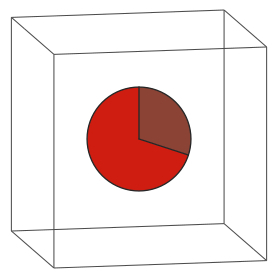
Three RenderStyle fields control the wedge layout:
wedge_start_anglesets the starting orientation (default 12 o’clock).show_wedge_edgestoggles radial edges between wedges (default on; set toFalseto stroke only the outer arc).vacancy_colouroverrides the vacancy fill (default: canvas background colour).
For example:
from hofmann import RenderStyle

style = RenderStyle(
    wedge_start_angle=0.0,        # start at 3 o'clock
    show_wedge_edges=False,       # outer arc only, no radial edges
    vacancy_colour="lightgrey",   # explicit vacancy fill
)
scene.render_mpl("structure.svg", style=style)
For more specific styling – for example, colouring all mixed sites
the same way to flag disordered positions – attach per-site data
with set_atom_data() and use the
colour_by parameter when rendering. See Colouring by per-atom data.
Visibility of constituent species
Setting visible to False hides every
site whose species is given as a plain label. It does not hide
that species when it appears as a constituent of a
Composition: a mixed site is always drawn with all of its
constituents, regardless of any per-species visible flag.
Bonding and polyhedra
A BondSpec or PolyhedronSpec rule applies to a
mixed site whenever any of its constituent species matches the rule.
Each pair of atoms still produces at most one bond, even when several
rules match: for a 70 / 30 Fe / Mn site bonded to an O neighbour,
defining both ("Fe", "O") and ("Mn", "O") rules gives one
bond, not two. When more than one rule matches a pair, the first in
list order wins. Vacancies never form bonds.
The half-bond at the mixed-site end is drawn in the colour of the dominant species – the constituent with the highest occupancy, with ties broken alphabetically.