Getting started
Installation
Install hofmann from PyPI:
pip install hofmann
For ASE interoperability (optional):
pip install "hofmann[ase]"
For pymatgen interoperability (optional):
pip install "hofmann[pymatgen]"
For animation export (optional):
pip install "hofmann[animation]"
For development (tests + docs):
pip install "hofmann[all]"
Requirements
Python 3.11+
numpy >= 1.24
matplotlib >= 3.7
scipy >= 1.10
ase >= 3.22 (optional, for
from_ase())pymatgen >= 2024.1.1 (optional, for
from_pymatgen())imageio >= 2.30 (optional, for
render_animation())imageio-ffmpeg >= 0.5 (optional, for MP4 output via
render_animation())
Rendering from an XBS file
The XBS .bs file format describes atoms, species styles, and bond
rules in a simple text format (see XBS file format).
from hofmann import StructureScene

scene = StructureScene.from_xbs("ch4.bs")
scene.render_mpl("ch4.svg")
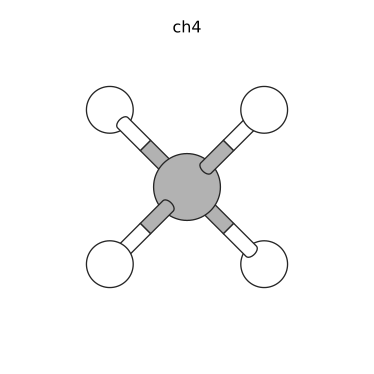
The output format is inferred from the file extension: .svg, .pdf,
and .png are all supported.
Rendering from ASE
If you have ASE installed, you can build a scene directly from an
Atoms object:
from ase.build import bulk
from hofmann import StructureScene, BondSpec

atoms = bulk("Si", "diamond", a=5.43)
bonds = [BondSpec(species=("Si", "Si"), max_length=2.8)]
scene = StructureScene.from_ase(atoms, bonds)
scene.render_mpl("si.pdf")
Both periodic and non-periodic Atoms objects are supported. For
periodic systems, fractional coordinates are wrapped into the unit cell
automatically. For non-periodic systems (molecules), Cartesian
positions are stored directly.
See from_ase() for full details.
Rendering from pymatgen
If you have pymatgen installed, you can build a scene directly from a
Structure object:
from pymatgen.core import Lattice, Structure
from hofmann import StructureScene, BondSpec

lattice = Lattice.cubic(5.43)
structure = Structure(
    lattice, ["Si"] * 8,
    [[0.0, 0.0, 0.0], [0.5, 0.5, 0.0],
     [0.5, 0.0, 0.5], [0.0, 0.5, 0.5],
     [0.25, 0.25, 0.25], [0.75, 0.75, 0.25],
     [0.75, 0.25, 0.75], [0.25, 0.75, 0.75]],
)

bonds = [BondSpec(species=("Si", "Si"), max_length=2.8)]
scene = StructureScene.from_pymatgen(structure, bonds)
scene.render_mpl("si.pdf")
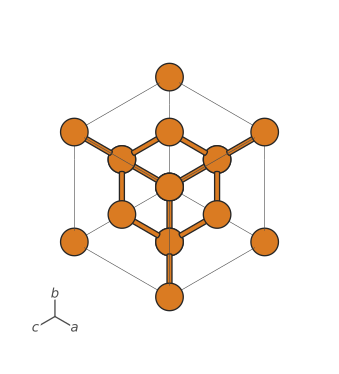
See from_pymatgen() for full details on periodic boundary
condition expansion and polyhedra support. Partial-occupancy and
solid-solution sites pass through automatically – see
Partial and mixed occupancy.